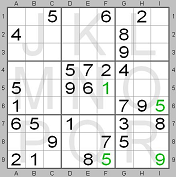
Here is a good Sudoku Program, which helps and assists you in solving any Sudoku puzzle.
This video really gives some good hints on how to solve Sudoku puzzles.
Showing posts with label Sudoku. Show all posts
Showing posts with label Sudoku. Show all posts
Sunday, December 27, 2009
Saturday, November 7, 2009
Sudoku: ‘X-Wing’, ‘Swordfish’ and ‘Jellyfish’ Clarified
These more difficult methods for candidate reduction in Sudoku are based on the relationship of a candidate number with both rows and columns. The X-wing is applied for two rows and two columns, the Swordfish for three rows and three columns and the Jellyfish for four rows and four columns. For an X-wing to be present the same candidate number must be present in all four squares where the rows and columns cross each other. For swordfish and jellyfish the candidate number in question need not be present in all the squares where the columns and rows cross each other. The rather odd names of these methods may relate very faintly to the outline of the involved squares with the candidate number in question. We will understand more of these difficult methods if we start with the simplest, namely the X-wing.
Sudoku X-wing – Rows/Columns
If the same candidate number within two rows is limited to the same two columns, then that number must necessarily be in two of the four ‘crossing-squares’ where the rows and columns cross each other. Since that number can only be once in each of the two columns, the candidate number can be removed from the two columns outside the two rows. This method, which focuses on two times two squares, is called an X-wing. We do not know in which two of the four ‘crossing-squares’ the number should be placed. Either the number should be placed as indicated by the \ part of the X or as indicated by the / part of the X. The exact place would become clear later in the solving process.

This board shows an 'X-wing' for candidate number 8 (shown in blue), which forms an X-wing in squares G2, G4, I2 and I4, because in rows 2 and 4 candidate number 8 is only present in columns G and I. So, in these columns candidate number 8 must be in rows 2 and 4. Therefore in these columns candidate number 8 can be removed from the other rows, here row 3 in squares G3 and I3 (shown in red).
 In the small picture you can see the final solution for this part of the board. In row 2 number 8 should be in square G2 and in row 4 number 8 should be in square I4.
Sudoku X-wing – Columns/Rows
If the same candidate number within two columns is limited to the same two rows, then that number must necessarily be in two of the four ‘crossing-squares’ (the X-wing) where the columns and rows cross each other. Since that number can only be once in each of the two rows, the candidate number can be removed from the two rows outside the two columns. We do not know in which two of the four ‘crossing-squares’ the number should be placed. Either the number should be placed as indicated by the \ part of the X or as indicated by the / part of the X. The exact place would become clear later in the solving process.

 This board shows an 'X-wing' for candidate number 5 (shown in blue), which forms an X-wing in squares H3, I3, H9 and I9, because in columns H and I candidate number 5 is only present in rows 3 and 9. So, in these rows candidate number 5 must be in columns H and I. Therefore in these rows candidate number 5 can be removed from the other columns, here columns D and F in squares D9 and F9 (shown in red).
In the small picture you can see the final solution for this part of the board. In column H number 5 should be in square H3 and in column I number 5 should be in square I9.
Sudoku Swordfish - Rows/Columns
If the same candidate number within three rows is limited to the same three columns, then that number must necessarily be in three of the ‘crossing-squares’ (the ‘swordfish’) where the rows and columns cross each other. Since that number can only be once in each of the three columns, the candidate number can be removed from the three columns outside the three rows. We do not know in which three of the ‘crossing-squares’ the number should be placed, only that it cannot be in the same row or column. Their precise position would become clear later in the solving process.

This board shows a 'Swordfish' for candidate number 2 (shown in blue), which forms a swordfish in squares A5, A8, A9, E5, E8, E9, F5 and F8, because in rows 5, 8 and 9 candidate number 2 is only present in columns A, E and F. So, in these columns candidate number 2 must be in rows 5, 8 and 9. Therefore in these columns candidate number 2 can be removed from the other rows, here row 4 in squares A4 and F4 (shown in red).

In the small picture you can see the final solution for this part of the board. Number 2 should in square A9 in column A, in square E8 in column E and in square F5 in column F.
Sudoku Swordfish – Columns/Rows
If the same candidate number within three columns is limited to the same three rows, then that number must necessarily be in three of the ‘crossing-squares’ (the ‘swordfish’) where the columns and rows cross each other. Since that number can only be once in each of the three rows, the candidate number can be removed from the three rows outside the three columns. We do not know in which three of the ‘crossing-squares’ the number should be placed, only that it cannot be in the same row or column. Their precise position would become clear later in the solving process.
 This board shows a 'Swordfish' for candidate number 8 (shown in blue), which forms a swordfish in squares A2, A4, C2, C5, E4 and E5, because in columns A, C and E candidate number 8 is only present in rows 2, 4 and 5. So, in these rows candidate number 8 must be in columns A, C and E. Therefore in these rows candidate number 8 can be removed from the other columns, here column F in squares F4 and F5 (shown in red).
In the small picture you can see the final solution for this part of the board. Number 8 should in square A2 in column A, in square C5 in column C and in square E4 in column E.
Sudoku Jellyfish - Rows/Columns
If the same candidate number within four rows is limited to the same four columns, then that number must necessarily be in four of the ‘crossing-squares’ (the ‘jellyfish’) where the rows and columns cross each other. Since that number can only be once in each of the four columns, the candidate number can be removed from the four columns outside the four rows. We do not know in which four of the ‘crossing-squares’ the number should be placed, only that it cannot be in the same row or column. Their precise position would become clear later in the solving process.
 This board shows a 'Jellyfish' for candidate number 2 (shown in blue), which forms a jellyfish in squares D3, D5, E2, E3, E5, G2, G3, G4, H2, H4 and H5, because in rows 2, 3, 4 and 5 candidate number 2 is only present in columns D, E, G and H. So, in these columns candidate number 2 must be in rows 2, 3, 4 and 5. Therefore in these columns candidate number 2 can be removed from the other rows, here row 1 in squares D1, E1 and H1 (shown in red).
 In the small picture you can see the final solution for this part of the board. Number 2 should in square D5 in column D, in square E2 in column E, in square G3 in column G and in square H4 in column H.
Sudoku Jellyfish – Columns/Rows
If the same candidate number within four columns is limited to the same four rows, then that number must necessarily be in four of the ‘crossing-squares’ (the ‘jellyfish’) where the columns and rows cross each other. Since that number can only be once in each of the four rows, the candidate number can be removed from the four rows outside the four columns. We do not know in which four of the ‘crossing-squares’ the number should be placed, only that it cannot be in the same row or column. Their precise position would become clear later in the solving process.

 This board shows a 'Jellyfish' for candidate number 8 (shown in blue), which forms a jellyfish in squares D2, D3, D8, F2, F7, F8, H2, H3, H7, H8, I2, I7 and I8, because in columns D, F, H, and I candidate number 8 is only present in rows 2, 3, 7 and 8. So, in these rows candidate number 8 must be in columns D, F, H and I. Therefore in these rows candidate number 8 can be removed from the other columns, here column E in squares E2, E3 and E7 (shown in red).
In the small picture you can see the final solution for this part of the board. Number 8 should in square D3 in column D, in square F8 in column F, in square H7 in column H and in square I2 in column I.
As you have seen these methods are not very easy to use. They need access to the candidate table and even then it may be difficult to spot a jellyfish or a swordfish. The X-wing, which is the simplest of these methods, may also be rather difficult to spot. To apply these methods in practice you would have great help of a user-friendly Sudoku program.
Sudoku X-wing – Rows/Columns
If the same candidate number within two rows is limited to the same two columns, then that number must necessarily be in two of the four ‘crossing-squares’ where the rows and columns cross each other. Since that number can only be once in each of the two columns, the candidate number can be removed from the two columns outside the two rows. This method, which focuses on two times two squares, is called an X-wing. We do not know in which two of the four ‘crossing-squares’ the number should be placed. Either the number should be placed as indicated by the \ part of the X or as indicated by the / part of the X. The exact place would become clear later in the solving process.

This board shows an 'X-wing' for candidate number 8 (shown in blue), which forms an X-wing in squares G2, G4, I2 and I4, because in rows 2 and 4 candidate number 8 is only present in columns G and I. So, in these columns candidate number 8 must be in rows 2 and 4. Therefore in these columns candidate number 8 can be removed from the other rows, here row 3 in squares G3 and I3 (shown in red).
 In the small picture you can see the final solution for this part of the board. In row 2 number 8 should be in square G2 and in row 4 number 8 should be in square I4.
 Sudoku X-wing – Columns/Rows
If the same candidate number within two columns is limited to the same two rows, then that number must necessarily be in two of the four ‘crossing-squares’ (the X-wing) where the columns and rows cross each other. Since that number can only be once in each of the two rows, the candidate number can be removed from the two rows outside the two columns. We do not know in which two of the four ‘crossing-squares’ the number should be placed. Either the number should be placed as indicated by the \ part of the X or as indicated by the / part of the X. The exact place would become clear later in the solving process.

 This board shows an 'X-wing' for candidate number 5 (shown in blue), which forms an X-wing in squares H3, I3, H9 and I9, because in columns H and I candidate number 5 is only present in rows 3 and 9. So, in these rows candidate number 5 must be in columns H and I. Therefore in these rows candidate number 5 can be removed from the other columns, here columns D and F in squares D9 and F9 (shown in red).
In the small picture you can see the final solution for this part of the board. In column H number 5 should be in square H3 and in column I number 5 should be in square I9.
Sudoku Swordfish - Rows/Columns
If the same candidate number within three rows is limited to the same three columns, then that number must necessarily be in three of the ‘crossing-squares’ (the ‘swordfish’) where the rows and columns cross each other. Since that number can only be once in each of the three columns, the candidate number can be removed from the three columns outside the three rows. We do not know in which three of the ‘crossing-squares’ the number should be placed, only that it cannot be in the same row or column. Their precise position would become clear later in the solving process.

This board shows a 'Swordfish' for candidate number 2 (shown in blue), which forms a swordfish in squares A5, A8, A9, E5, E8, E9, F5 and F8, because in rows 5, 8 and 9 candidate number 2 is only present in columns A, E and F. So, in these columns candidate number 2 must be in rows 5, 8 and 9. Therefore in these columns candidate number 2 can be removed from the other rows, here row 4 in squares A4 and F4 (shown in red).

In the small picture you can see the final solution for this part of the board. Number 2 should in square A9 in column A, in square E8 in column E and in square F5 in column F.
Sudoku Swordfish – Columns/Rows
If the same candidate number within three columns is limited to the same three rows, then that number must necessarily be in three of the ‘crossing-squares’ (the ‘swordfish’) where the columns and rows cross each other. Since that number can only be once in each of the three rows, the candidate number can be removed from the three rows outside the three columns. We do not know in which three of the ‘crossing-squares’ the number should be placed, only that it cannot be in the same row or column. Their precise position would become clear later in the solving process.
 This board shows a 'Swordfish' for candidate number 8 (shown in blue), which forms a swordfish in squares A2, A4, C2, C5, E4 and E5, because in columns A, C and E candidate number 8 is only present in rows 2, 4 and 5. So, in these rows candidate number 8 must be in columns A, C and E. Therefore in these rows candidate number 8 can be removed from the other columns, here column F in squares F4 and F5 (shown in red).
In the small picture you can see the final solution for this part of the board. Number 8 should in square A2 in column A, in square C5 in column C and in square E4 in column E.
Sudoku Jellyfish - Rows/Columns
If the same candidate number within four rows is limited to the same four columns, then that number must necessarily be in four of the ‘crossing-squares’ (the ‘jellyfish’) where the rows and columns cross each other. Since that number can only be once in each of the four columns, the candidate number can be removed from the four columns outside the four rows. We do not know in which four of the ‘crossing-squares’ the number should be placed, only that it cannot be in the same row or column. Their precise position would become clear later in the solving process.
 This board shows a 'Jellyfish' for candidate number 2 (shown in blue), which forms a jellyfish in squares D3, D5, E2, E3, E5, G2, G3, G4, H2, H4 and H5, because in rows 2, 3, 4 and 5 candidate number 2 is only present in columns D, E, G and H. So, in these columns candidate number 2 must be in rows 2, 3, 4 and 5. Therefore in these columns candidate number 2 can be removed from the other rows, here row 1 in squares D1, E1 and H1 (shown in red).
  In the small picture you can see the final solution for this part of the board. Number 2 should in square D5 in column D, in square E2 in column E, in square G3 in column G and in square H4 in column H.
Sudoku Jellyfish – Columns/Rows
If the same candidate number within four columns is limited to the same four rows, then that number must necessarily be in four of the ‘crossing-squares’ (the ‘jellyfish’) where the columns and rows cross each other. Since that number can only be once in each of the four rows, the candidate number can be removed from the four rows outside the four columns. We do not know in which four of the ‘crossing-squares’ the number should be placed, only that it cannot be in the same row or column. Their precise position would become clear later in the solving process.

 This board shows a 'Jellyfish' for candidate number 8 (shown in blue), which forms a jellyfish in squares D2, D3, D8, F2, F7, F8, H2, H3, H7, H8, I2, I7 and I8, because in columns D, F, H, and I candidate number 8 is only present in rows 2, 3, 7 and 8. So, in these rows candidate number 8 must be in columns D, F, H and I. Therefore in these rows candidate number 8 can be removed from the other columns, here column E in squares E2, E3 and E7 (shown in red).
In the small picture you can see the final solution for this part of the board. Number 8 should in square D3 in column D, in square F8 in column F, in square H7 in column H and in square I2 in column I.
As you have seen these methods are not very easy to use. They need access to the candidate table and even then it may be difficult to spot a jellyfish or a swordfish. The X-wing, which is the simplest of these methods, may also be rather difficult to spot. To apply these methods in practice you would have great help of a user-friendly Sudoku program.

Saturday, October 24, 2009
Boost Your Child's Brainpower with Sudoku
In less than a year the Sudoku bug has infected huge numbers of the UK population, and it is fast spreading across the world! Why has a simple logic puzzle become so popular, and how can your kids benefit?
Sudoku puzzles were first published in the US in the 1970s and are sometimes known as "Number Squares". They have been popular for many years in Japan, where the name "Sudoku" (meaning "single number") was coined. The current craze was started late in 2004 when a UK newspaper started publishing the puzzles. Within weeks the puzzles were picked up in other newspapers and Sudoku became the pastime of choice for commuters, parents – and even kids!
From a parent’s point of view, Sudoku puzzles are perfect for long journeys, waiting rooms, and rainy afternoons. They are being found more and more in the classroom as teachers wake up to their benefits and use them as time-fillers for children who finish early, as whole class activity, or as "homework". Indeed, the UK government-produced Teachers magazine has recommended that Sudoku puzzles are used in the classroom as brain exercise!
As well as developing your child's logic and reasoning skills and concentration, Sudoku puzzles, if done at the right level, build your child's confidence. Children of all abilities enjoy the challenge of a Sudoku puzzle, if the puzzle is age-appropriate. Bear in mind that many of the puzzles published in newspapers are too difficult for younger children, so it is worth seeking out puzzles made especially for kids. Children as young as five years old can try the 4x4 grids, then build up to the 6x6 grids and finally the traditional 9x9 sudoku grid.
Why are Sudoku so appealing? Firstly, although Sudoku grids usually use numbers, your child does not need mathematical skills to solve the puzzles – only logic. Using logical reasoning appropriate to his/her age, your child decides how to place numbers into a Sudoku grid. There is only one correct answer for each puzzle, no guessing is necessary, and the rules are easy to learn. The more puzzles you do, the better you become. Each puzzle typically takes a child about 20-30 minutes to complete, and gives them a real sense of satisfaction when finished!
And that, really, is the secret of their popularity. You feel good when you finish one! And then you want to try another one, and another ….
Lindsay Small is the owner of Activity Village, packed full of fun and educational activities for kids. Do you have children aged 2-10? Visit http://www.ActivityVillage.co.uk to find free kids crafts, printables, educational resources, worksheets, coloring pages and puzzles, jigsaws and, of course, Sudoku puzzles!
Article Source: http://EzineArticles.com/?expert=Lindsay_Small
Sudoku puzzles were first published in the US in the 1970s and are sometimes known as "Number Squares". They have been popular for many years in Japan, where the name "Sudoku" (meaning "single number") was coined. The current craze was started late in 2004 when a UK newspaper started publishing the puzzles. Within weeks the puzzles were picked up in other newspapers and Sudoku became the pastime of choice for commuters, parents – and even kids!
From a parent’s point of view, Sudoku puzzles are perfect for long journeys, waiting rooms, and rainy afternoons. They are being found more and more in the classroom as teachers wake up to their benefits and use them as time-fillers for children who finish early, as whole class activity, or as "homework". Indeed, the UK government-produced Teachers magazine has recommended that Sudoku puzzles are used in the classroom as brain exercise!
As well as developing your child's logic and reasoning skills and concentration, Sudoku puzzles, if done at the right level, build your child's confidence. Children of all abilities enjoy the challenge of a Sudoku puzzle, if the puzzle is age-appropriate. Bear in mind that many of the puzzles published in newspapers are too difficult for younger children, so it is worth seeking out puzzles made especially for kids. Children as young as five years old can try the 4x4 grids, then build up to the 6x6 grids and finally the traditional 9x9 sudoku grid.
Why are Sudoku so appealing? Firstly, although Sudoku grids usually use numbers, your child does not need mathematical skills to solve the puzzles – only logic. Using logical reasoning appropriate to his/her age, your child decides how to place numbers into a Sudoku grid. There is only one correct answer for each puzzle, no guessing is necessary, and the rules are easy to learn. The more puzzles you do, the better you become. Each puzzle typically takes a child about 20-30 minutes to complete, and gives them a real sense of satisfaction when finished!
And that, really, is the secret of their popularity. You feel good when you finish one! And then you want to try another one, and another ….
Lindsay Small is the owner of Activity Village, packed full of fun and educational activities for kids. Do you have children aged 2-10? Visit http://www.ActivityVillage.co.uk to find free kids crafts, printables, educational resources, worksheets, coloring pages and puzzles, jigsaws and, of course, Sudoku puzzles!
Article Source: http://EzineArticles.com/?expert=Lindsay_Small
Subscribe to:
Posts (Atom)